 BACK TO Thought Leadership
Purchase Price Allocation Accounting for Founders: A Guide for Owner-Operators
You just closed the deal. The ink is dry. After years of grinding, you've finally earned this moment—the relief, the excitement, the absolute readiness for what’s next.
But just as you’re turning your focus to growth, a new team shows up talking about something called purchase price allocation accounting, or PPA. And your gut tightens. You're a builder, not a bean counter.
The Ink Is Dry. So Why Are Accountants Suddenly in My Office?

"Purchase price allocation accounting" sounds like one more piece of corporate jargon meant to distract you from the real work of running your business. We get it. As founders ourselves, we know how it feels to be pulled into processes that seem miles away from building products and serving customers.
This isn’t just about ticking a box for the accountants. PPA is the critical process of connecting the price your new partner paid for the business to the actual assets on its new balance sheet. It’s how the story of your company—everything you built, from brand reputation to customer loyalty—gets translated into the financial reality of the combined entity.
From Deal Price to Day-One Balance Sheet
Think of it as opening the books for the first time as a new company. The deal price reflects your company’s total value, future potential and all. But accounting rules demand this price gets broken down and assigned to specific assets and liabilities.
It’s about identifying everything you own and giving it a fair market value.
- Tangible Assets: The easy stuff—laptops, office furniture, equipment.
- Identifiable Intangible Assets: This is where the real value in a modern business lives. We’re talking customer relationships, proprietary tech, brand name, and non-compete agreements.
- Goodwill: What’s left of the purchase price after every other asset is valued. It’s the premium paid for the things you can't put on a spreadsheet: your team's unique culture, your operational secret sauce, and the momentum you’ll build together.
When the final contract for the sale of a business is signed, it kicks off this essential accounting exercise. Getting PPA right directly impacts the company’s financial statements, tax strategy, and reported profits for years.
This isn't about you becoming an accountant. It's about owning your company's financial story post-acquisition and making sure the foundation for the next chapter of growth is built with intention.
A real partner will pull you into this process, not shield you from it. Why? Because you know the business better than anyone. Your insights are what give the numbers their real-world texture.
If you're just starting to think about what a sale or partnership could look like, our founder-focused content on mergers and acquisitions can help demystify the road ahead.
What Does Purchase Price Allocation Accounting Actually Mean for Your Business?
Let’s cut through the accounting-speak. At its heart, purchase price allocation accounting (PPA) is the process of taking the total price paid for your business and assigning it piece by piece to everything acquired. The official rulebook is ASC 805 under U.S. GAAP, but the idea is much more intuitive than it sounds.
Think of it like buying a fully-loaded car. You agree on one price, but that price covers the engine, the chassis, the leather seats, and the fancy sound system. Each component has its own value. PPA applies that same logic to your business.
Deconstructing the Deal Price
The first step is a deep dive to take inventory and value everything that makes your company tick. A team of accountants and valuation pros will go through and assign a fair market value to two big buckets of assets:
- Tangible Assets: The straightforward stuff you can physically touch—inventory, machinery, computers, and any real estate you own.
- Intangible Assets: This is where we quantify the "secret sauce" you've built. Think customer relationships, proprietary software, your brand reputation, patents, and key contracts.
Of course, before the accountants can even start this breakdown, the lawyers need to finalize the deal's legal framework, usually in an asset purchase agreement. This document clearly defines what’s being bought and sold, setting the stage for the financial allocation.
Goodwill is More Than an Accounting Plug
So, what happens after every single asset and liability gets a value assigned to it? Any portion of the purchase price that’s left over is recorded as goodwill.
Don't mistake this for a simple accounting entry. Goodwill is the tangible value of the intangible momentum you’ve built—the stuff that couldn’t be itemized, like your team’s culture, your market reputation, and your proven ability to execute. It’s the premium paid for your company's future potential.
This process has become a massive part of M&A. The rules around PPA, especially since ASC 805 became law in 2009, have completely changed the landscape. Before, many deals could sidestep goodwill. Now, over 95% of business combinations demand a full PPA. As a result, goodwill has ballooned from roughly 30% of the average purchase price in 2000 to an expected 60% or more by 2026.
This isn't just an accounting exercise. The outcome of your PPA directly shapes your new balance sheet, your company’s tax obligations, and its reported profitability for years to come.
Takeaway: A good partner doesn't just present the final numbers to you; they build them with you. Your insight is what ensures the financial story reflects the reality you spent years creating.
The PPA Playbook for Founders and Operators
When you’re a founder going through an acquisition, the purchase price allocation process can feel like a black box. It’s an accounting exercise, sure, but it’s one you have a surprising amount of influence over.
Think of it less as a rigid set of rules and more as a playbook. Your job isn't to become a CPA overnight. It’s to understand the game so you can help your new partners get the details right—because those details have long-term consequences for the business. Let's walk through it from an operator's perspective.
Step 1: Lock Down the Total Purchase Price
First things first: you have to agree on the total purchase consideration. This isn’t just the cash that lands in your bank account. It’s the total value changing hands, and it often has several moving parts.
As a founder, you know the deal terms better than anyone. You need to make sure the accounting team captures everything:
- Cash Paid: The straightforward part.
- Rolled-Over Equity: The ownership you're keeping in the new company. This gets valued at its fair market price on the day the deal closes.
- Assumed Debt: If your partner is taking your company's existing debt off your hands, the value of that debt is part of the price they're "paying."
- Contingent Consideration (Earnouts): Those future payments you’ll get for hitting specific performance targets. These are valued based on the probability of hitting those milestones.
Getting this total number right is the bedrock for the entire PPA. Every dollar of value has to be accounted for and allocated from this pool.
Step 2: Identify Every Asset and Liability
With the total price locked, the valuation team starts what looks like an exhaustive inventory of your company. They're tasked with identifying every single asset and liability involved in the deal, digging much deeper than your standard balance sheet.
This is where your operational knowledge is absolutely critical. An accountant can find what’s on the books. Only you know where the hidden value is. You can point to the proprietary tech you built, the informal customer relationships that drive recurring revenue, or the specific team culture that makes your business hum.
Your input here is what stops valuable, off-balance-sheet assets from getting missed and simply dumped into goodwill by default.
This is a simple flow, but it shows how we get from the total price to the final goodwill number.
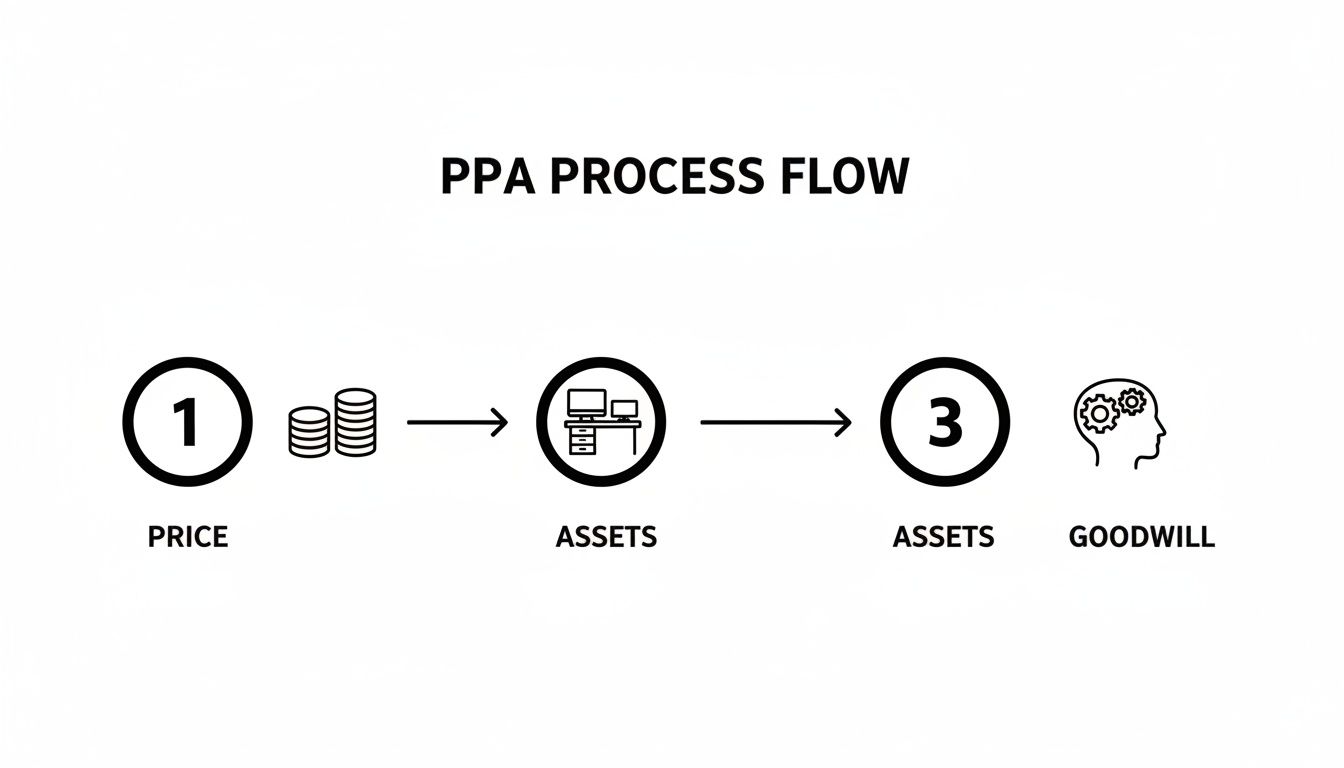
As you can see, the purchase price is the starting point. It gets systematically carved up and assigned to all the identifiable assets before whatever is left over becomes goodwill.
Step 3: Assign a Fair Value to Each Piece
Once the inventory is complete, it's time to assign a dollar value to every item. This is the heart of the purchase price allocation accounting exercise. From laptops and office furniture to customer contracts and brand names, everything gets a fair value assigned as of the acquisition date.
Valuing tangible assets is usually pretty easy. Intangibles are trickier. This is where complex models come into play, and you absolutely have the right to ask questions about the assumptions being used. After all, it's your business they're valuing.
Step 4: Calculate Goodwill
After every identifiable asset (both tangible and intangible) has been valued and liabilities are subtracted, you do the final math.
Goodwill = Total Purchase Price – Fair Value of Net Identifiable Assets
That's it. Goodwill is simply the premium the acquirer paid for all the incredible things about your business that couldn't be itemized and valued separately. It’s the value of your reputation, your assembled team, your operational know-how, and your future growth potential, all rolled into one.
Step 5: Document the Opening Balance Sheet
Finally, all this work gets rolled up into the new company's opening balance sheet. This document is the starting line for your next chapter of growth. How it’s structured will impact your company's reported profits, tax planning, and key financial metrics for years to come.
To make this feel more concrete, here's a quick checklist that breaks down what each stage of the PPA really means for you as the operator.
The Founder's PPA Checklist
| Stage | What It Means for You | Key Outcome |
|---|---|---|
| 1. Confirm Price | Make sure all deal components (cash, equity, earnouts) are included. | An accurate total purchase consideration figure. |
| 2. Identify Assets | Your chance to point out the "hidden" value in your operations and team. | A complete inventory of tangible and intangible assets. |
| 3. Value Assets | Gut-check the assumptions used to value key intangibles like your brand or tech. | Fair values assigned to every identified asset and liability. |
| 4. Calculate Goodwill | See what premium was paid for your company's reputation and future potential. | The final goodwill amount is calculated as the remainder. |
| 5. Finalize Books | Review the new balance sheet that will set the stage for future reporting. | A new, post-acquisition opening balance sheet. |
Takeaway: Your role isn't just to watch this happen; it’s to be an active guide. By providing the essential context that only you have, you help ensure the final PPA truly reflects what makes your business valuable.
For more insights on thriving after a deal, check out our other resources on M&A for founders.
Valuing the Invisible Assets That Drive Your Growth

For most companies we partner with—especially in tech, healthcare, and professional services—the real value isn't in the office furniture or the laptops. It's in the things you can’t touch.
These are your intangible assets, built over years of sweat and late nights. They’re the competitive moat you dug, the secret sauce in your offering, and the reason customers keep coming back.
The purchase price allocation accounting process demands you put a number on them. This isn't just some accounting drill. It’s one of the most critical steps in a deal, and it will shape your company's financial story for the next decade.
Putting a Number on Your Competitive Moat
The valuation team’s job is to pinpoint and measure every intangible asset that makes your business tick. This is where you, the founder, are indispensable. You know what truly drives value, far beyond what’s captured in a contract.
Here’s what they’ll be looking at:
- Customer Relationships: We're talking about the real value of your recurring revenue and loyal client base. Valuators will dig into churn rates and customer lifetime value to forecast the cash flow from the relationships you’ve already built.
- Proprietary Technology: This is your custom-built software, your unique process, or a specific methodology that nobody else has. Its value is often figured by what it would cost to build from scratch or the income it's projected to bring in.
- Brand and Trademarks: What’s your name worth in the market? This is often valued with the "relief from royalty" method—a fancy way of asking what you'd have to pay to license your own brand if you didn't own it.
Some firms see these as "soft" assets. We see them as the engine of your business. Your job is to make sure the valuation team understands the story—and the hard-won value—behind each one.
Why the Useful Life of an Asset Matters
Assigning a value is only half the battle. The other crucial piece is determining each asset’s useful life—the estimated time it will continue to generate cash flow.
This number is a big deal because it determines your amortization expense. Think of amortization as a non-cash charge that slowly writes down the value of your intangibles over time. It shows up on your income statement and directly reduces your reported profits (EBITDA).
A shorter useful life means higher annual amortization, which pushes your reported earnings down. A longer useful life spreads out that expense, making your reported profits look healthier each year. This isn't just a rounding error. A recent analysis of public M&A deals showed that intangibles made up 25-35% of total purchase prices, with assets like customer relationships often getting useful lives of 12-15 years. You can see more detailed PPA trends to get a feel for how this plays out in different industries.
Takeaway: Don't let your company's most valuable assets get mispriced or mischaracterized. Be in the room. Ask the hard questions. Getting the valuation of intangibles right isn’t about playing accounting games; it's about having a clear view of your company’s financial narrative after the deal closes.
Goodwill: The Most Misunderstood Number on Your New Balance Sheet
So, you’ve closed the deal. The PPA is done, and you’re looking at your new balance sheet. Staring back at you is a massive number called goodwill—often the single largest asset on the books.
It’s easy to write this off as an accounting gimmick. Just a plug to make the debits and credits balance, right?
Wrong. That number is the real, financial recognition of everything your partner paid a premium for. It’s the value of your rockstar team, your hard-won reputation, and the operational momentum that can’t be neatly itemized on a spreadsheet.
Why Goodwill Isn't Just Another Asset
Unlike your newly valued customer list or brand, goodwill isn’t amortized down on a predictable schedule. Instead, accounting rules demand it be tested for impairment at least once a year.
Think of it as a recurring health check on the investment. Your finance team has to ask: is the business still generating the value we expected when we paid that price? If the company’s fair value dips below its book value, you’ve got a big problem.
And this isn't a small-time number. A comprehensive analysis from Stout found that goodwill makes up an average of 62% of total purchase prices in M&A deals. This shows that acquirers are paying huge premiums for precisely what goodwill represents: synergies, market position, and the assembled talent that drives future growth. You can see the full breakdown in Stout’s comprehensive PPA study.
The Real Risk of Impairment
Failing an impairment test means you must record an impairment charge, writing down the value of goodwill. This charge flows directly to the income statement, instantly turning a profitable year into a reported loss.
It's a non-cash expense, so it doesn't drain your bank account today. But the ripple effects are serious.
- It spooks your stakeholders. Investors, lenders, and your board will see the write-down as a massive red flag that the business is failing to meet expectations.
- It can trigger loan covenant violations. Many debt agreements are tied to net worth or profitability metrics. A large impairment can put you in technical default.
- It kills morale. A public admission that the deal isn't living up to its promise can create doubt and uncertainty across your entire team.
Takeaway: Goodwill isn't a passive accounting entry; it’s a living measure of the deal's success. Protecting its value means being relentless about hitting the growth targets that justified the purchase price. It's the ultimate scorecard for your partnership.
Common PPA Traps That Catch Founders Off Guard
The purchase price allocation process is full of technical landmines, and the scar tissue from getting it wrong can last for years. It’s tempting to check out and just let the “experts” handle it. This is a huge mistake.
From our experience sitting on both sides of the table, we see founders fall into the same few traps. The single biggest one is disengagement. You’ve just sprinted through a grueling deal process, and the idea of diving into another round of spreadsheets is exhausting.
But leaving the PPA entirely to the accountants is like letting a stranger write the first chapter of your new company’s story.
The Danger of Hands-Off Leadership
When you step back, you give up your most important role: keeper of your company’s context. No valuation expert, no matter how skilled, understands the soul of your business the way you do. Without your guidance, they’re just looking at data.
This is where things go sideways:
- Mischaracterizing Assets: They might undervalue the proprietary software your team spent five years perfecting because they don’t see its strategic moat.
- Ignoring Key Relationships: The value of a decade-long, handshake-deal customer relationship might get missed entirely, lumping its value into goodwill by default.
- Distorting Future Earnings: Using generic industry lifespans for assets can create amortization schedules that don’t reflect your reality, artificially depressing profits for years to come.
Your engagement isn’t optional. You earned your seat at that table, and your insights are what will make the final numbers real.
Forgetting the Tax Man
Another classic trap is assuming the PPA for your financial statements is the same one used for taxes. It almost never is.
The rules for book (GAAP) and tax accounting are different worlds, which means you’re actually running two separate PPA exercises. An asset might be amortized over 15 years for tax purposes but only five years for your books.
This gap creates something called a deferred tax liability—a future tax bill that gets booked on your new balance sheet from day one. If you're not expecting it, seeing this new liability can be a nasty surprise.
A great partner doesn’t hide this from you; they walk you through it. This kind of transparency is a non-negotiable sign of a healthy partnership. It’s proof that your new partner wants you to build with eyes wide open.
Questions You Should Be Asking
You don’t need to become a CPA overnight, but you do need to ask sharp questions. Start here:
- “Walk me through the assumptions for our key intangibles. How did you land on that useful life?” Challenge them. If an assumption feels off, say so and explain why.
- “How is this PPA different from the one for tax? Show me the impact on our deferred tax liability.” Make them connect the dots for you.
- “Which assets are we valuing that we couldn't before? How does that change our financial story going forward?” This helps you own the new narrative.
This process is the first real test of your new partnership. As we explored in a recent discussion on demystifying M&A with our operating partners, true alignment is forged in these moments of open, direct communication.
Takeaway: Own your new balance sheet. It’s the foundation for everything you’re about to build. Don't delegate your understanding of it.
Your Questions on PPA Answered
Even for seasoned operators, purchase price allocation accounting can feel like a black box. You’ve got questions. We’ve been in the trenches and have the straight answers. Let’s tackle the ones we hear most from founders.
How Long Does the Purchase Price Allocation Process Take?
The PPA clock starts the moment the deal closes, but it’s not an overnight job. The official accounting rules give everyone a “measurement period” of up to one year to get the numbers dialed in.
Think of it as a sprint followed by a marathon. Most of the heavy lifting happens in the first three to six months. But don’t be surprised when small tweaks and refinements happen right up until that one-year mark as new information surfaces.
Can I Actually Influence the PPA Outcome?
Absolutely. In fact, you must. While the process follows strict accounting rules (ASC 805), your deep knowledge is the most critical input. You’re the one who understands the customer relationships, the secret sauce in your tech, and the true competitive moats you’ve built.
A good partner won’t just allow your input; they’ll demand it. Your insights are the difference between an asset you spent a decade building getting its proper value or being lost in the shuffle. It's about making sure the final numbers tell the true story of your business.
What Is the Difference Between Amortization and Depreciation?
They’re two sides of the same coin, just for different types of assets.
- Depreciation is for the tangible stuff you can touch—your buildings, equipment, and company trucks. It’s how you expense their cost over their useful life.
- Amortization is the exact same idea, but for your intangible assets. This is how you expense the value of things like customer lists, patents, and brand names over their useful life.
Both are non-cash expenses that reduce an asset’s value on the books and lower your taxable income along the way.
What Happens If Goodwill Is Impaired?
If your annual impairment test shows that your company's fair value has dropped below what it’s worth on the balance sheet, you have to write it down. This is recorded as an impairment loss—a non-cash charge that hits your net income directly.
While it doesn’t pull cash out of your bank account, a goodwill impairment is a major warning shot. It can signal real problems in the business, put you at odds with your lenders, and shake investor confidence. It’s a painful reminder of how important it is to keep the momentum going long after the deal is signed.
At Rallyday Partners, we believe in building with clarity and conviction from day one. If you're a founder thinking about your next chapter and want a partner who speaks your language, we'd love to hear your story.


