 BACK TO Thought Leadership
How to Raise the Price Without Losing Customers
You're probably underpriced. For most founders, that's not news, but the thought of having to raise the price is a gut punch. You know it’s a critical lever for growth, yet it brings a tidal wave of anxiety. What if our customers leave? What if our competitors pounce? What if they think we're getting greedy?
You’ve poured everything into this business. You've built relationships, solved real problems, and earned your customers' trust. So when it's time to talk about charging more, it feels personal. Almost like a betrayal. That feeling of being alone with a hard decision is something every founder we partner with knows well.
We see this hesitation constantly. But here’s the hard truth, from one operator to another: avoiding this conversation is a slow-motion strategic failure. It’s one of the most common ceilings we see founders place on their own growth. This playbook is built on scar tissue, designed to help you raise prices with confidence and actually strengthen the relationships you've worked so hard to build.
Why You Need to Raise the Price (Even When It’s Hard)

Stagnant pricing isn't just a number on a spreadsheet; it's a real constraint on your company's future. Every dollar you leave on the table is a dollar you can't reinvest in the business, your team, or your customers.
Think about what that really means.
- You can't hire the A-player who would unlock your next phase of growth.
- You can't fund the product roadmap your customers keep asking for.
- You can't reward your best people, leaving them open to being poached.
- You can't build a balance sheet strong enough to weather a storm or seize an M&A opportunity.
Avoiding the price conversation doesn’t protect your company. It starves it.
This isn't about greed. It’s about building a resilient, enduring company. We need to reframe this from "taking more" to "earning the right to deliver more" by capturing the value you've already created.
Pricing is a reflection of confidence—in your team, your product, and the value you deliver. The most successful founders we partner with don't see pricing as a one-time event. They see it as a muscle that needs to be exercised regularly. Of course, this requires a massive amount of honesty, which is why developing a culture of candor is one of the most critical skills for any scaling leader.
Takeaway: A price increase is a referendum on the value you've created. Before you act, conduct a ruthless self-assessment of your retention, competitive standing, and value proposition to ensure you’ve earned the right to ask for more.
Are You Ready? A Brutally Honest Gut Check
Before you touch your pricing page, you need to earn the right to ask for more. Announcing a price hike from a shaky foundation is a recipe for a self-inflicted wound. It’s like trying to build a second story when the first floor is already cracking.
This isn’t about a generic checklist. It's about looking for real-world proof that you've delivered enough new value to justify asking customers for more.
Look for Strong Signals, Not Wishful Thinking
A traditional PE firm might look at your P&L, see a quick way to juice margins, and push for an immediate, across-the-board price hike. That's the spreadsheet view. An operator's view—our view—asks a different question: Has the business truly earned this?
Here are the signals that tell you the answer is a firm "yes":
- Ironclad Customer Retention: Are your customers sticking around without you needing to constantly resell them? High net revenue retention (NRR) is the ultimate proof that you’re delivering on your promise. If they’re consistently upgrading or expanding, you've created undeniable value.
- A Crystal-Clear Value Prop: Can your team—and more importantly, your customers—articulate exactly what problem you solve and why you’re the best choice? If the answer is fuzzy, you have a messaging problem, not a pricing problem. Fix that first.
- Healthy Unit Economics: Do you actually make money on each customer? If your cost to acquire a customer (CAC) is higher than their lifetime value (LTV), raising prices is just a band-aid on a much deeper issue. You need a sustainable model before you start optimizing it.
These aren’t just metrics on a dashboard. They're vital signs of a healthy, resilient business that has earned its market’s trust.
Map Your Real Competitive Landscape
Knowing where you stand isn’t just about looking in the mirror; it’s about understanding the world outside your walls. Don't just scan your competitors' pricing pages. Dig deeper.
Ask these questions:
- Where do you consistently win? When you land a deal against a competitor, what’s the real reason? Is it a specific feature, your service model, or the trust you've built?
- Where do you lose? Be honest. When you lose a deal, is it always about price, or is there a genuine gap in your product or service?
- Who is the 'do nothing' competitor? Often, your biggest rival isn't another company—it's customer inertia. What’s the real cost and pain of them not using a solution like yours at all?
Your ability to command a premium is directly tied to the distance between your solution and the next-best alternative. If that gap is wide and obvious, you have pricing power. If it’s narrow, a price hike will just push customers across the aisle. This is where making sharp, decisive judgments separates great leaders from the rest.
Takeaway: Don't confuse activity with progress. A price hike is justified only by tangible signals of value: strong retention, clear differentiation, and a healthy business model.
Redesigning Your Pricing to Tell a Value Story
Simply tacking 20% onto your old plans is the lazy route. It’s tactical when you need to be strategic. Raising your price is a golden opportunity to rethink how you package and communicate your value from the ground up.
This isn't just a price hike. It's a pricing redesign, aimed at aligning what you charge with the real-world value you deliver.
Don't Just Change the Price, Change the Conversation
Your pricing page is one of the most critical marketing assets you have. It tells customers what you stand for, who you serve best, and what their growth journey with you looks like.
Before you touch the numbers, answer a few tough questions:
- What’s our core value metric? What is the unit of value that grows as your customer gets more successful with your product? Is it users, projects, revenue generated, or something else? Your price needs to scale along this axis.
- Which features are our MVPs? Pinpoint the features your best customers absolutely cannot live without. These are your levers for creating compelling upgrade paths.
- Where do customers get stuck? Dive into your data to find friction points. These are goldmines—perfect opportunities to create higher-value tiers or add-on services.
This isn't about squeezing customers. It's about building a clear, logical bridge between the price they pay and the value they get.
We see this all the time with founders in consulting and professional services. The moment they shift from hourly billing to outcome-based packages, the entire client relationship changes. The conversation moves from "how many hours did you work?" to "what result did we achieve?" That’s the heart of value-based pricing.
Structure Tiers to Guide, Not Confuse
Your pricing tiers need to tell a simple, compelling story. A confused mind never buys. The right choice for each customer should feel obvious.
We often guide founders through a "Good, Better, Best" framework.
- Good (The Foot in the Door): Solves a core problem for a specific user. It’s built to prove your value fast and get them hooked, with clear limits that naturally encourage growth into the next tier.
- Better (The Bullseye): This is your target. It’s where most of your ideal customers should land, delivering the full solution for their biggest problems.
- Best (The Aspiration): For power users and enterprise clients who need it all—advanced features, white-glove support, and every resource you offer. This tier also acts as a powerful value anchor, making your "Better" plan look incredibly reasonable.
Before you decide to raise prices, do your homework. Looking into a proven agency pricing strategy, for instance, can give you battle-tested frameworks for packaging services—insights surprisingly relevant for many SaaS and tech businesses. That research helps you build tiers that are both profitable and genuinely customer-friendly.
Takeaway: Stop treating your pricing as just a number. Redesign your packaging to tell a crystal-clear value story. Use tiers to make the right choice obvious for your customers and turn your best features into strategic tools for growth.
An Operator's Playbook for Rolling Out the Change
You can have the most elegant, data-backed pricing in the world, but if you botch the rollout, it’s all for nothing. Execution is everything. This is where scar tissue matters. You have to manage the human side of this change with directness and respect.
Get Your Internal House in Order First
Before a single customer hears a whisper about new pricing, your team needs to be in perfect lockstep. If they're confused or uncertain, that anxiety will bleed straight into customer conversations.
Get your sales, marketing, and customer success leaders in a room. Walk them through the why behind the change, not just the what.
- Arm them with talking points, not scripts. Give them confident, value-focused answers to the tough questions they’re guaranteed to get.
- Role-play the hard conversations. Practice handling the angry customer or a tough negotiation. This builds muscle memory and real confidence.
- Define the guardrails. What’s negotiable? What isn’t? Empower your team with clear rules of engagement so they know when to be flexible and when to hold the line.
Your team’s confidence—or lack thereof—will set the tone for the entire customer experience.
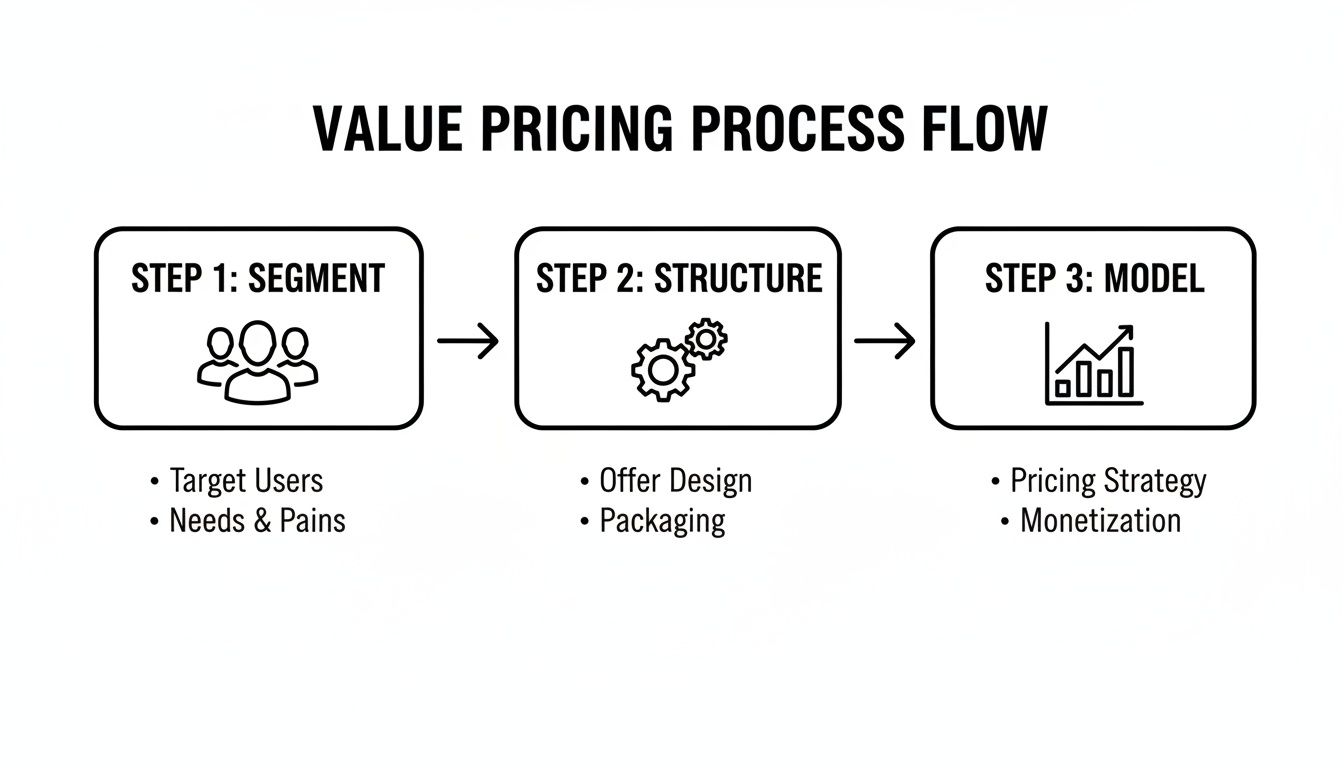
A successful price adjustment isn't a single event. It's a methodical process rooted in customer understanding and strategic modeling.
Crafting the Customer Communication Plan
Once your team is aligned, it’s time to face your customers. How you deliver the news is just as important as the news itself. Honesty and empathy are your best moves.
The biggest mistake we see founders make is apologizing for a price increase. Don't. Your communication must be direct and anchored to the value you're delivering. You are not taking more; you are earning more by reinvesting in the product they depend on.
Your plan needs to be segmented. A one-size-fits-all email blast is just lazy.
- Your Champions (Top 10%): These are the customers who love you and send referrals. They deserve a personal touch. A call from you, the founder, or their dedicated account manager goes a long way. Thank them for their partnership and explain the changes directly.
- Long-Time Loyal Customers: These folks have been with you for years. Honor that loyalty. Give them the most lead time—90-120 days is a solid rule of thumb. This shows respect and gives them plenty of time to budget.
- Newer Customers: For anyone who signed up more recently, a shorter notice of 30-60 days is usually fine. They bought into your current value proposition, so the change will feel less dramatic.
Your announcement email should never be a wall of text. Be clear and direct. Start by reinforcing the value you've added, state the change, explain why it’s necessary for future growth, and clearly outline what happens next.
Takeaway: Your rollout plan is as important as your pricing strategy. Align your team first, then communicate to customers with segmented, direct, and value-focused messages. Never apologize for earning your value.
Handling Pushback and Strengthening Trust

Let's be clear: even with a perfectly executed plan, some customers will be upset when you raise the price. It's a guarantee. How you handle that pushback is a defining moment for your brand.
This is where you show what you’re made of. Is churn just a cost of doing business, or is it a signal to listen harder and turn friction into an opportunity for deeper trust? For us, it’s always the latter.
Empower Your Team with Principles, Not Scripts
Your customer success team is on the front lines. The worst thing you can do is hand them a rigid script. It’s inauthentic and escalates tension. Instead, empower them with guiding principles to navigate tough conversations with empathy and authority.
Here’s what that looks like:
- Start with Empathy. The first words should always be, "I understand." This validates their feelings and de-escalates the situation.
- Re-Center on Value. Gently steer the conversation away from cost and back to the value they get. Ask questions like, "Can we talk about the results you’ve seen since you started?"
- Know When to Hold, When to Fold. Give your team clear guardrails. Maybe they can offer a one-time credit for a high-value customer. But they also need to know when the answer is a firm, respectful "no."
This approach teaches your people to think like owners, not just ticket-closers.
Differentiate Noise from Signal
Not all feedback is created equal. You have to learn to filter legitimate feedback from the chronic complainers. Overreacting to the "squeaky wheels" is a classic founder mistake.
Pay special attention to the quiet churn—the good-fit customers who leave without a word. Their departure is often the most important signal you’ll get. Tools like customer retention software can help, but nothing beats active listening.
Ultimately, handling pushback well is a masterclass in founder leadership. It's about standing confidently in your value while building enduring trust with the people who matter most.
Takeaway: Prepare for pushback by giving your team principles, not scripts. Learn to distinguish noise from signal, and use these moments of friction to reinforce customer relationships and prove your brand’s character.
Build Your Pricing Powerhouse in 2026
This playbook isn’t about a one-time price bump. It’s about building a permanent capability inside your company. Pricing isn’t a chore you tackle every few years; it’s a core competency—a powerful engine for compounding growth.
The founders who win don’t just have a great product. They have a pricing powerhouse. It’s a culture where the entire team understands that price is a direct reflection of the value you create and the confidence you have in your mission.
You don't just set a price; you earn it every single day. The price tag is the last step in a long process of creating real value, building trust, and solving problems better than anyone else.
This is the essence of building with intention. Every dollar you rightfully earn is catalytic capital. It’s fuel you can reinvest to go even bigger—to hire better talent, build a better product, and serve your customers on a completely different level. Shifting your mindset to raise the price from a defensive tactic to an offensive strategy is one of the most powerful moves a founder can make.
Takeaway: Stop treating pricing as a painful necessity. Start treating it as the strategic lever it truly is—the ultimate reflection of your value and the fuel for your biggest ambitions.
If you’re a founder who has earned the right to go bigger but aren’t sure how to take the next step, let’s talk. Rallyday Partners was built by operators who have been in your shoes, and we’d love to hear your story. Learn more about our by founders, for founders approach at https://rallydaypartners.com.


