


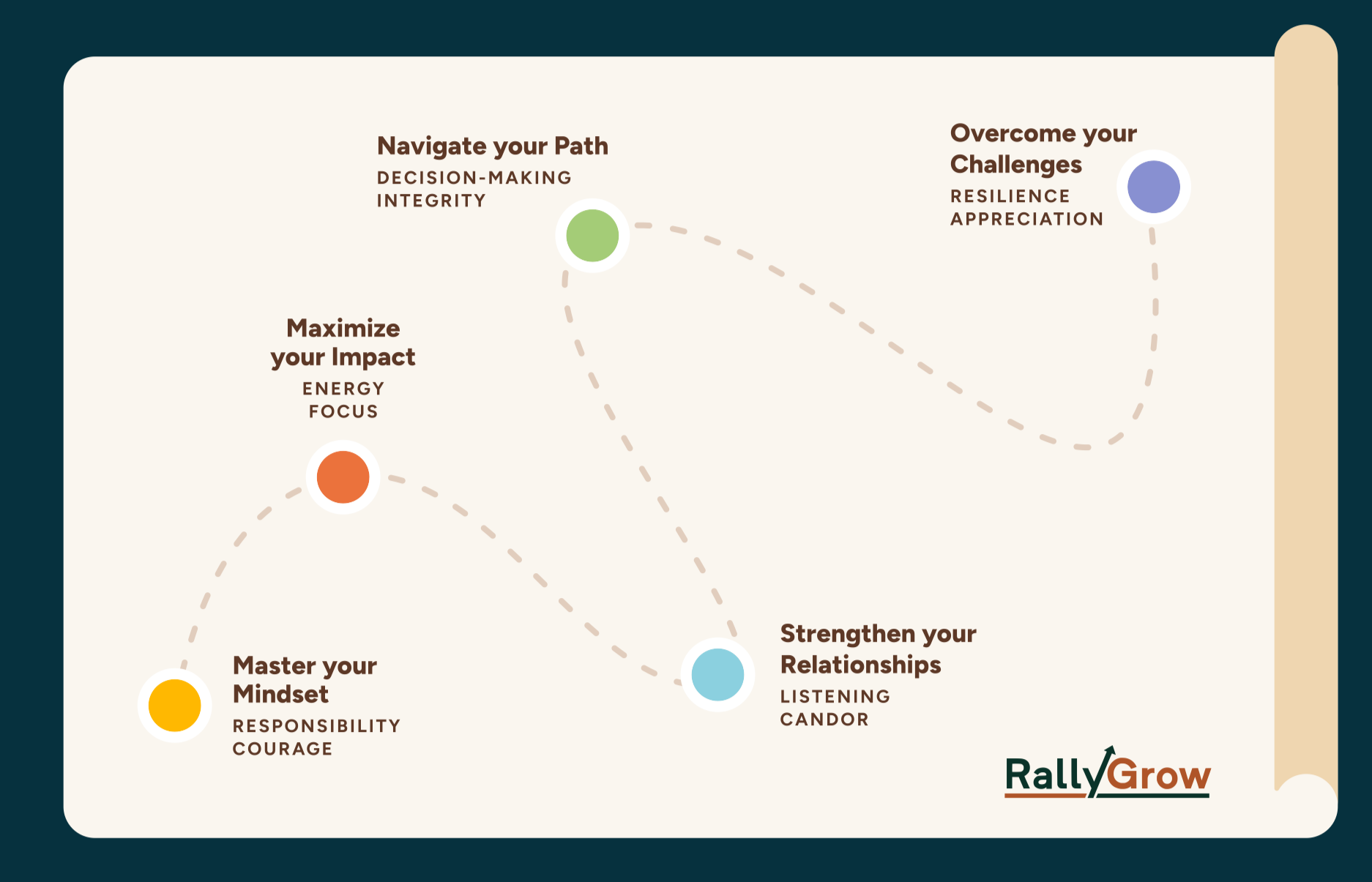
This post is part of our RallyGrow series, covering 10 human skills that drive real impact in life and work.
You’ve probably heard the phrase “time is money.” But here’s the truth most high performers eventually learn: energy is the real currency.
It doesn’t matter how many hours you put in if you’re constantly drained, distracted, or disengaged. You can be doing all the right things on paper and still feel like you’re running on fumes.
That’s why Energy Management is one of the foundational human skills we cover in the RallyGrow program. It’s about learning how to protect, renew, and direct your energy toward what matters most.
Energy is a Skill, Not a Trait
Most people treat energy like something that just happens to them. You’re either “feeling it” or you’re not. But the truth is, energy is something you can learn to manage, just like your calendar or your inbox.
In the RallyGrow course, we look at energy through three lenses:
- Mental energy (focus, clarity, creativity)
- Physical energy (your stamina, movement, rest, and recovery)
- Emotional energy (your mood, outlook, and ability to connect)
These aren’t isolated. They interact constantly. A poor night of sleep affects your patience. An unresolved conversation at work can leave you mentally fried. A scattered to-do list can drain your motivation before you’ve even started.
The key is noticing where your energy is going and choosing how to redirect it.
Why This Matters for Leaders and Teams
When you lead others, your energy becomes contagious. If you’re burnt out, people feel it. If you’re calm and focused, it gives them permission to do the same.
Strong leaders don’t just manage tasks. They manage the emotional and energetic tone of the room. That’s what keeps teams aligned, grounded, and effective especially in high-pressure moments.
We talk about the Benefits and Types of Play (for Adults) in the course summarized below. Why should kids be the only ones who have all the fun?
- Social Play: Engaging with others, whether through conversation, friendly competition, or just goofing around.
- Creative Play: Activities like drawing, writing, or crafting—anything that lets you create something from nothing.
- Imaginative Play: This could be storytelling, daydreaming, or even acting out scenarios. It’s about letting your imagination take the lead.
- Physical Play: Engaging in physical activity, whether it’s sports, dancing, hiking, or just a spontaneous game of catch.
- Game Play: This includes board games, puzzles, or any form of structured play with set rules — great for the competitive spirit!
- Playful Thinking: Solving riddles, brain teasers, or engaging in activities that challenge your mind in a fun way.
Simple shifts that help
Energy management isn’t about totally overhauling your life. Often, it starts with small, deliberate choices:
- Taking a 5-minute walk between back-to-back meetings
- Starting your day with focus work, not email
- Scheduling something fun or nourishing at the end of a tough week
- Noticing when you’re drained and asking, “What do I need right now?”
Little shifts in how you spend your time can lead to big shifts in how you feel.
One Last Question
If your energy is your most valuable resource, are you spending it frivolously or investing it with purpose?
That’s the challenge and invitation of this skill. Be a little more intentional. Listen to your body. Pay attention to your mind. Refuel before you’re running on empty.
When your energy is strong, you think clearer. You lead better. You show up more fully in the places that matter.
And that’s what real impact looks like.
We invite you to explore these concepts more deeply through the resources below.
Quick Hits
Short reads, videos, and podcasts to get inspired and start applying right away.
- Read or Listen to “Manage Your Energy, Not Your Time” (Harvard Business Review, 2007)
- Read How to find your zone of genius by Mathilde Collin and perform an Energy Audit
Deeper Dives
Books and long-form content for when you want to go further into the ideas and practices.
- Listen to Burnout Is Everyone’s Problem | WorkLife with Adam Grant
- Read Behave: The Biology of Humans at Our Best and Worst by Robert M. Sapolsky or listen to his explanation in this video (1h13m).
Next up, we’ll be talking about Focus!
Interested in learning more or exploring RallyGrow? Email rallygrow@rallydaypartners.com to inquire and request access.

